
How FinTech Can Modernize the Partial Credit Guarantee Scheme (PCGS) and Expand MSME Access to Finance
As Uzbekistan accelerates its digital financial transformation, the future of MSME finance may depend not only on more credit, but on smarter guarantees. This analysis explores how AI, alternative data, digital platforms, Open Banking and fintech innovation could transform Partial Credit Guarantee Schemes (PCGS) into next-generation digital financial infrastructure.
Bu içerik şu şirket tarafından desteklenmektedir:
Fintech Association of Uzbekistan
Şirket profilini görüntüle →FT Analiz | Editörün Notu
Özbekistan, son yıllarda finansal altyapısını dijitalleştirme ve KOBİ'lerin finansmana erişimini güçlendirme hedefi doğrultusunda önemli adımlar atıyor. Bu dönüşüm yalnızca bankacılık sistemini değil; Partial Credit Guarantee Scheme (PCGS) modellerini, fintech ekosistemini, dijital platformları ve veri temelli finansman yaklaşımlarını da yeniden şekillendiriyor.
Aşağıda yer alan analiz; Dünya Bankası'nın FINGROW Programı, Uzum, Xolis (PAYNET) ve Özbekistan'da gelişen dijital finans ekosisteminden hareketle, yapay zekâ, alternatif veri kaynakları, Open Banking ve Open Finance yaklaşımlarının KOBİ finansmanını nasıl dönüştürebileceğini ele alıyor. Aynı zamanda garanti mekanizmalarının geleneksel risk paylaşımı modellerinden, API tabanlı ve veri odaklı dijital finansal altyapılara evrilebileceğine ilişkin bir perspektif sunuyor.
Uluslararası okuyucu kitlesi de dikkate alınarak hazırlanan bu çalışma, özgün dili olan İngilizce olarak yayımlanmaktadır.
Full Analysis (English)
How FinTech Can Modernize the Partial Credit Guarantee Scheme (PCGS) and Expand MSME Access to Finance
Micro, small and medium-sized enterprises (MSMEs) are the backbone of Uzbekistan’s economy. According to the latest World Bank data, MSMEs account for more than 90% of all businesses, approximately 75% of total employment and around 55% of the country’s GDP. Despite their significant role, access to finance remains one of the greatest barriers to growth. While MSMEs represent the overwhelming majority of businesses, only around 10% of small enterprises and 16% of medium-sized enterprises have access to formal bank financing, leaving an estimated USD 6 billion financing gap.
The challenge is no longer simply how to expand guarantee funds, but how to transform guarantee schemes into digital, data-driven infrastructure that is seamlessly embedded into the financing journey of every entrepreneur.
Moving from Traditional Guarantees to Digital Ecosystems
Traditionally, obtaining a guaranteed loan involves multiple manual steps. An entrepreneur applies to a bank, the bank submits a guarantee request, documents are reviewed manually and only then is financing approved.
The next generation of guarantee schemes should operate very differently. Entrepreneurs should be able to complete the entire financing journey digitally—from onboarding and electronic KYC to AI-assisted credit assessment, automated guarantee approval, digital signatures and loan disbursement—through a seamless digital experience.
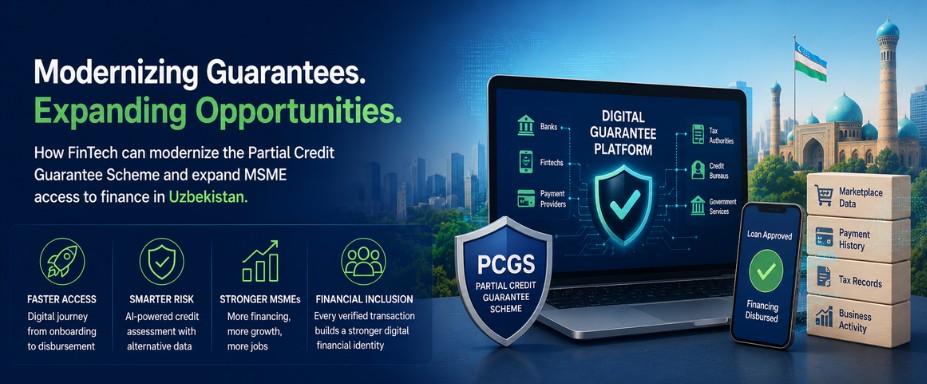
This requires transforming the Partial Credit Guarantee Scheme into a Digital Guarantee Platform connected through APIs with banks, non-bank financial institutions, fintech lenders, payment providers, tax authorities, credit bureaus and government digital services. Such integration would significantly reduce processing times, lower operational costs, improve transparency and enable real-time monitoring of guarantee portfolios.
As Uzbekistan continues to modernize its financial infrastructure, API-based interoperability and future Open Banking and Open Finance initiatives could further strengthen these digital guarantee ecosystems.
The Platform Economy Creates Digital Financial Identities
One of the most important developments in financial services is the emergence of the platform economy. Digital platforms are no longer simply marketplaces; they generate trusted financial data that can significantly improve the assessment of an entrepreneur’s creditworthiness.
Platforms such as Uzum Market and other digital commerce ecosystems provide MSMEs with access to digital markets while simultaneously creating verified commercial data through everyday business activity.
Instead of relying exclusively on collateral and financial statements, financial institutions can increasingly assess businesses using alternative data sources such as:
- Digital payment history
- Marketplace sales
- Tax records
- QR payment turnover
- Accounting data
- Utility payment records
- Logistics activity
- Customer ratings and transaction history
Every verified digital transaction contributes to building a stronger digital financial identity for an entrepreneur.
Case Study: Uzum Ecosystem
Uzum demonstrates how integrated digital ecosystems can support financial inclusion. By combining a marketplace, digital payments, payment cards, embedded financing and microfinance services within a single ecosystem, the platform generates valuable behavioural and transactional data. Subject to customer consent and regulatory safeguards, this information can support more accurate credit assessments and improve financing opportunities for MSMEs.
Case Study: Xolis
Another promising example is Xolis, a digital platform launched by PAYNET for entrepreneurs and self-employed businesses. Xolis enables digital business registration, bookkeeping, tax calculation, fiscal receipt management and business turnover monitoring.
Beyond simplifying administration, platforms such as Xolis generate verified business information that could-with appropriate customer consent and regulatory safeguards—provide financial institutions with a more accurate understanding of actual business activity, reducing reliance on paper-based documentation.
Data Aggregation and AI-Driven Credit Assessment
The future of MSME finance lies in intelligent data aggregation.
By securely combining information from payment providers, marketplaces, accounting platforms, tax authorities, credit bureaus and government databases, lenders can build a far more comprehensive understanding of a business than traditional financial statements alone can provide.
Artificial Intelligence further enhances this capability by analysing thousands of variables simultaneously, enabling financial institutions to:
- Make faster lending decisions;
- Improve risk assessment;
- Reduce fraud;
- Expand access to finance for businesses without traditional collateral or lengthy credit histories.
For countries such as Uzbekistan, where many entrepreneurs have limited formal financial histories, AI-powered alternative credit assessment has the potential to become a powerful driver of financial inclusion.
However, AI also introduces important governance considerations. Models trained solely on historical lending data may unintentionally disadvantage women entrepreneurs, rural businesses, young entrepreneurs or first-time borrowers. Therefore, AI-driven credit assessment should remain transparent, explainable and subject to regular governance, validation and independent auditing to ensure fairness and accountability.
BNPL as a Financial Inclusion Instrument
Uzbekistan has developed one of Central Asia’s most dynamic Buy Now, Pay Later (BNPL) ecosystems.
Unlike many international markets where BNPL primarily supports short-term instalment purchases, the Uzbek market has evolved to meet local consumer needs. Financing frequently supports purchases ranging between USD 300 and USD 500, with repayment periods extending well beyond twelve months in many cases.
As a result, BNPL has evolved beyond a consumer finance product into an important financial inclusion mechanism, enabling households to finance essential goods such as home appliances, electronics, furniture and education despite limited access to traditional bank lending.
In addition, BNPL providers generate valuable behavioural information regarding repayment discipline and affordability. Subject to customer consent and appropriate regulatory safeguards, these data sets could complement traditional credit assessments and further expand access to finance.
As the market continues to mature, an appropriate regulatory framework will remain essential to ensure consumer protection while supporting innovation and sustainable market development.
The Future of Digital Guarantee Schemes
The next generation of Partial Credit Guarantee Schemes should evolve from simple risk-sharing mechanisms into digital financial infrastructure.
Rather than operating separately from the market, guarantee platforms should integrate with fintech companies, banks, payment providers, digital platforms, accounting systems, government databases and credit bureaus. This would enable automated guarantee issuance, AI-assisted risk assessment, continuous portfolio monitoring and significantly faster access to finance for MSMEs.
Digital guarantee platforms should also extend beyond loan origination. By leveraging real-time payment data, marketplace activity, accounting information and other trusted digital data sources, guarantee providers can continuously monitor portfolio performance, identify early warning signals and improve risk management throughout the entire loan lifecycle. This transforms guarantee schemes from static guarantee funds into dynamic digital financial infrastructure.
The future of MSME finance is platform-based, AI-enabled and data-driven. The objective should not simply be to provide more guarantees, but to build an ecosystem in which every verified transaction strengthens an entrepreneur’s digital financial identity.
By leveraging digital platforms, trusted data, AI-powered credit assessment and embedded finance, Uzbekistan has an opportunity to build a financing ecosystem that is faster, more inclusive, more transparent and better equipped to support long-term sustainable economic growth.
References
- World Bank. Improved Access to Finance to Help 7,000 Businesses in Uzbekistan Grow and Create Jobs (2025).
- World Bank. Uzbekistan – Access to Finance for Jobs and Growth (FINGROW) Project – Project Appraisal Document (2025).
- World Bank. Access to Finance for Jobs and Growth (FINGROW) Program Documentation.
- KPMG Uzbekistan. Fintech Uzbekistan – Payments, POS Financing & BNPL Report (BNPL market outlook and projections).
Sesli Dinle
Özbekistan Fintech Derneği Başkanı
Nargis Dustmatova, Özbekistan Fintech Derneği Başkanı ve JSC Paynet Yönetim Kurulu Üyesi'dir. Uluslararası pazarlarda 20 yılı aşkın deneyimiyle dijital finans, inovasyon, girişimcilik, finansal kapsayıcılık ve kadının ekonomik güçlenmesi alanlarında öncü inisiyatifler yürütmektedir.